

 ENG
ENG  FRE
FRE  ESP
ESP  KOR
KOR 
The current brutal large-scale military conflicts worldwide leave no doubt that global security is going through one of the hardest challenges ever. Overcoming this is truly a critical mission for the planet in order to secure the future. However, quite often the solutions offered lack the climate dimension, since there has been a popular belief that climate change has a rather indirect connection with peacebuilding. This is obviously not the case. There has been abundant evidence in recent years showing that global peace cannot be achieved without climate mitigation.
First, climate change tremendously increases rivalry for the most vital resources. This includes water access, food and land. Roughly two billion people globally do not have access to safe drinking water (UN SDG Report 2022) and about half of mankind has severe water scarcity for at least part of the year (Sixth Assessment Report IPCC). Based on the data of the Global Commission on the Economics of Water, the planet faces “the prospect of a 40% shortfall in freshwater supply by 2030 with severe shortages in water constrained regions”. This means that the situation has strong potential to worsen. Coupled with land degradation caused by a changing climate through droughts, desertification and other extreme weather events, there will be a decrease in the volume of territory suitable for living and agriculture. With projected problems with the food supply and population growth (Sixth Assessment Report IPCC), this creates a fundamental basis for the increased potential for conflict, along with existing myriad territory disputes worldwide as a perfect catalyst.
Second, climate change creates a solid socio-economic platform for future conflicts. The negative effects of climate change hit more severely low income countries and people living in poverty (OECD). Climate change fuels hunger, inequity and social injustice, thus creating profound social imbalances on all levels: international, national and local. It is also a root of displacement and forced migration at unprecedented levels. According to the World Food Program, extreme weather events forced the migration of 30 million people in 2020. All this leads to the fact that millions of people might be left with very limited opportunities for a decent future, which in turn can be systematically used by various populists, radicals and even extremist groups building their political capital on provoking conflicts.
Third, regions and territories most vulnerable to military conflicts and to climate change have a big overlap in geography. Many of the top 15 countries most vulnerable to climate change have experienced or are currently experiencing intensive military conflicts.
Table. The 15 countries most vulnerable to climate change
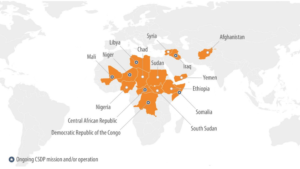
This geographical coincidence puts additional pressure on future global security.
Finally, climate change seriously limits the capabilities of the international community to create efficient resistance to those forces that boost violent conflicts. The severe consequences of climate change simply take too many resources to resolve, leaving very little capacity to overcome additional challenges, such as potential conflicts. The price of climate change from not only the human but also the economic perspective is vast. According to the Potsdam Institute for Climate Impact Research, global annual damages are estimated to be at 38 trillion US dollars, with a likely range of 19-59 trillion US dollars in 2050.
Therefore, the struggle for stopping climate change is essential to providing the planet with lasting peace. The right time to take action!
Ivan Filippov. a member of the Global Greens Climate Working Group